

WAGO 750-881 Discontinued: What Now?
The WAGO 750-881 and 750-880 are discontinued and WAGO-I/O-PRO is no longer supported. What this means for existing plants and the two realistic ways forward.
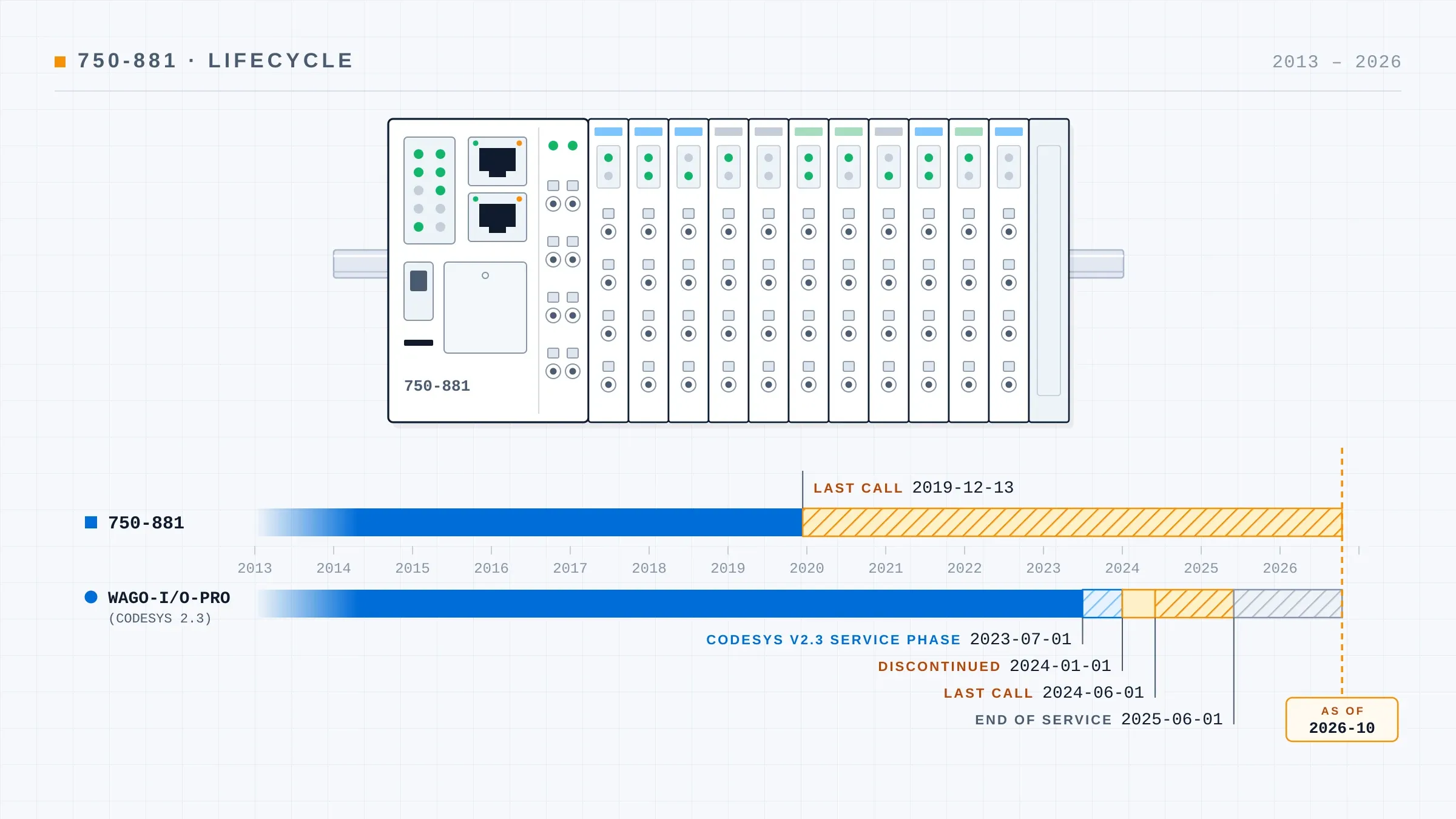
The WAGO 750-881 is a programmable ETHERNET controller, third generation according to the WAGO product page, that has not been orderable from WAGO since its last call on 13 December 2019. Plenty of them still run every day, in ventilation and pumping systems, on conveyor lines and in building services. Discontinued does not mean broken. It means that spare units and the programming environment are getting scarce, and that the decision about a successor is better made before a failure makes it for you.
This article is for maintenance technicians, plant engineers and project managers with a 750-881, its sibling the 750-880, or the older 750-841 in the field. It covers what the discontinuation actually means, what to secure right now, and when swapping the controller within the WAGO range is enough versus when moving to Siemens makes more sense.
1.What the WAGO 750-881 discontinuation actually means
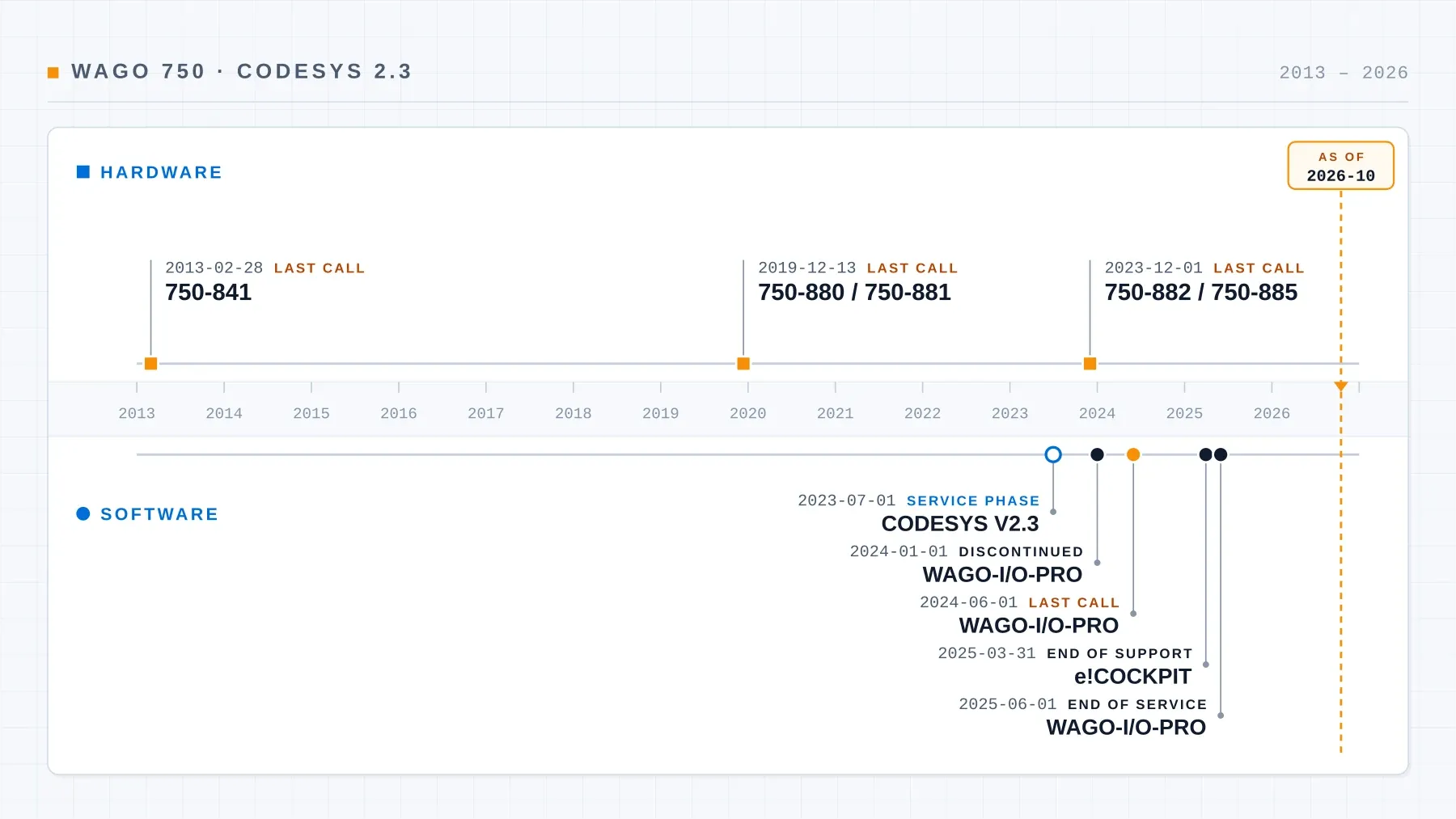
According to the WAGO data sheet, the last call for the 750-880 and 750-881 was 13 December 2019. Since then, new units come only from remaining stock or the second-hand market, with no manufacturer warranty.
The bigger risk sits in the software. The 750-881 is programmed with WAGO-I/O-PRO (item 759-333), which is CODESYS 2.3 plus WAGO target files. WAGO's end-of-life notice sets these dates for it:
- discontinuation on 1 January 2024
- last call on 1 June 2024
- service until 1 June 2025
The foundation underneath has stopped moving too. Since 1 July 2023, CODESYS has listed version 2.3 on its lifecycle page as being in the service phase: it is no longer sold for new projects and no longer maintained on the vendor's own initiative, and existing customers can only commission fixes as a paid service.
In practice: anyone who wants to add a valve, change a setpoint permanently or fix a logic error today needs a working WAGO-I/O-PRO installation, a PC that still runs it, and the matching source project. If one of the three is missing, it is the change that stops, not the plant.
1.1.The substitutes named in the data sheet
The 750-881 data sheet lists two product substitutes: the 750-891 (Modbus TCP) and the 750-893 (EtherNet/IP). Both are fourth-generation controllers, as stated in the 750-891 manual and the 2019 discontinuation letter. The catch is that they too are programmed with WAGO-I/O-PRO. A WAGO staff member put it plainly on the WAGO Community: the 750-08xx controllers run CODESYS 2.3 only, the 750-8xxx range runs CODESYS 3.5, although for the PFC models only from the second generation onwards (more on that below). A 750-891 solves the spare-part problem for now. It does not solve the software problem.
2.First step: secure the 750-881 program while it still runs
Securing the program works differently on WAGO than on a Siemens S7, and it is exactly where many retrofit plans come unstuck.
2.1.Is there a source archive on the controller?
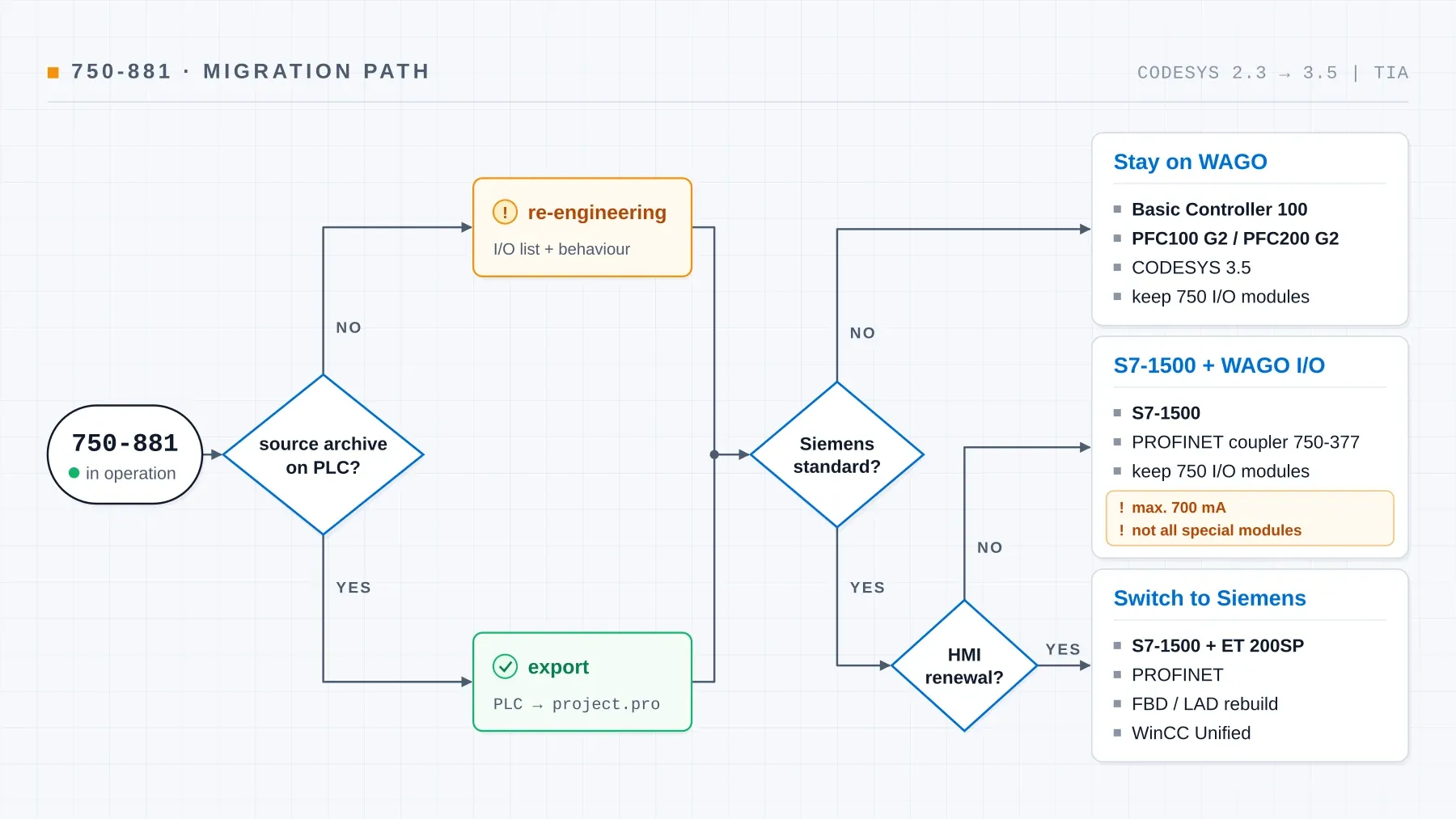
What runs on the controller is the boot project, a compiled image. It cannot be turned back into readable code, and CODESYS 2.3 has no upload-without-project of the kind S7 users are used to. The program can only be recovered if the source code was transferred to the controller at the last download. WAGO-I/O-PRO has a dedicated command for this ("Sourcecode download" in the English interface); a project stored that way can be retrieved through the Open dialog, which can also load a project directly from the controller.
Usually nobody remembers whether that was done. So the first question for the existing installation is not "which hardware" but "does the project still exist, and where": on the controller, on the old programming laptop, at the machine builder, or in the folder of someone who left years ago.
2.2.Reading a project without the target
Often the .pro file turns up but the WAGO target files are missing. For analysis, that is still enough. CODESYS 2.3 loads the file without the manufacturer target; you only acknowledge a message that the target system information cannot be read. After that, POUs, actions and the task configuration are all there in the object tree. What is missing is the hardware side: the PLC configuration with modules and addresses stays empty.
"Project → Export" produces an .exp file. That is the readable source, easy to search and archivable independently of CODESYS. A schematic excerpt of a program with one action:
(* @NESTEDCOMMENTS := 'Yes' *)
(* @PATH := '' *)
(* @OBJECTFLAGS := '0, 8' *)
(* @SYMFILEFLAGS := '2048' *)
PROGRAM PLC_PRG
VAR
    xAnforderung : BOOL;
    xStoerung    : BOOL;
    xPumpeEin    : BOOL;
END_VAR
(* @END_DECLARATION := '0' *)
Pumpe_Steuern;
END_PROGRAM

ACTION	Pumpe_Steuern:
xPumpeEin := xAnforderung AND NOT xStoerung;
END_ACTION
For Structured Text, that gives you the complete code. CFC blocks are a different matter: the export holds elements and connection numbers but no pin names, which have to be matched from the declarations. The PDF printout from "Project → Document" is of little help with large CFC charts.
Work on a copy, never the original
Only open a copy of the .pro file, do not save it, and compare the checksum of the original before and after. CODESYS creates helper files when opening a project, and an accidental save without the target alters it. The same discipline applies at the running controller: no download, no online change, and keep your hands off the STOP switch and the reset button.
2.3.I/O list, device status and spares
Because the PLC configuration is missing when you read without the target, the hardware is recorded on site. Photograph the module sequence, log every module with its item number, note any bus extensions. The controller's web-based management (WBM) shows the device status in a browser without changing anything on the PLC.
Then the spares question: how many controllers of this type run on site, how many are in stock, and what does an hour of downtime cost? One spare controller in the cabinet buys time. It does not replace a decision.
WAGO-I/O-PRO is only available through WAGO
The software was never freely distributed. WAGO supplies the installer and target files through its after-sales support, usually against proof of a purchased licence. Ask for version 2.3.9.73 or later: CODESYS V2.3 before 2.3.9.73 has a vulnerability that can be exploited through manipulated .pro files (CODESYS Advisory 2024-01).
3.Option A: stay with WAGO and replace only the controller
For many plants this is the smallest intervention, and it is worth saying so. The reason is the local bus. The manuals for the second-generation PFC100 and the second-generation PFC200 both state that all available I/O modules of the WAGO I/O System 750/753 can be connected to the controller. The same applies to the Basic Controller 100, with 64 modules without and 250 with bus extension. The 750-881 data sheet gives the same limits.
Modules, wiring and circuit diagrams stay as they are. What changes is the head of the station.
3.1.Which controller can take over
The item number matters here, because not every PFC runs CODESYS 3.5:
- Basic Controller 100 (750-8000, 750-8001): according to a WAGO staff member on the community forum, the functional replacement for the 750-890, 750-891 and 750-893, programmed with CODESYS 3.5 according to its manual. The WAGO data sheet (copy at Reichelt) lists Modbus TCP and UDP as its fieldbus.
- PFC100 G2 (750-811x) and PFC200 G2 (750-821x): Linux-based, more interfaces. According to the WAGO notice on WAGO-I/O-PRO, the PFC200 G2 is programmed with CODESYS 3.5 from firmware 23; up to firmware 22 it ran e!COCKPIT. The firmware thread on the WAGO Community describes the same boundary.
- Avoid: the first-generation PFC100 (750-8101, 750-8102) and the PFC200 G1 (750-820x). According to WAGO staff on the community forum (PFC100, PFC200), they cannot be programmed with CODESYS 3.5, only with the equally discontinued e!COCKPIT or CODESYS 2.3.
One detail that gets missed: according to its data sheet, the 750-881 spoke EtherNet/IP as well as Modbus TCP. If a supervisory system talks to the controller over EtherNet/IP, the successor has to offer that interface, or the supervisory side has to change too.
3.2.Where the work still is
A CODESYS 2.3 project has to be ported to CODESYS 3.5. The free CODESYS V2.3 Converter opens and imports V2.3 projects in CODESYS 3.5; it has itself been in the service phase since 1 March 2026. After the import, the hardware configuration, library calls and any existing WebVisu have to be checked and adapted for the new controller. The effort depends heavily on program size and on how many libraries are in use.
Porting to CODESYS 3.5 is not something I offer; my work is in TIA Portal. For this route, a WAGO system partner or a CODESYS programmer is the right contact, and for a single WAGO station in an otherwise consistent plant it is often the sensible choice.
4.Option B: move to Siemens S7-1500 and TIA Portal
Switching to Siemens is the bigger step. It pays off not because Siemens is better, but when the surroundings point that way:
- The site or the group has standardised on Siemens.
- In-house maintenance knows TIA Portal, but nobody knows CODESYS any more.
- The spare parts store is built around S7 and ET 200, not WAGO.
- The HMI is due for replacement anyway.
- There are several WAGO islands that should gradually be brought onto one platform.
When two or three of these apply, "replace the controller" quickly turns into "maintain two platforms indefinitely", which in my assessment is usually the more expensive option over ten years.
4.1.What gets rebuilt
There is no tool that converts a CODESYS project into TIA Portal. What gets transferred is the function: the exported code is read, written down as a functional description and rebuilt in TIA Portal. For migrations, my preferred target languages are FBD and LAD, because maintenance staff can follow the online status signal by signal and see which condition is missing. SCL is reserved for calculations and data handling, encapsulated in dedicated blocks. The reasoning behind that split is in the article on PLC programming languages under IEC 61131-3.
On the hardware side, an S7-1500 and an ET 200SP on PROFINET take over the role of controller and modules. The old WebVisu cannot be converted; it is rebuilt in WinCC Unified, keeping the screen structure and alarm texts from the existing system. How such a rebuild runs as a project is described on the CODESYS to TIA Portal migration page.
4.2.A middle route: keep the modules, change the controller
If the cabinet should stay untouched, the WAGO modules can also continue as distributed I/O under an S7-1500. The 750-377 fieldbus coupler connects them as a PROFINET IO device, configured through its GSDML file. Two limits belong in the planning. The coupler supplies 700 mA total current to the modules, where the 750-881 had 1,700 mA according to its data sheet. And some special modules, such as the IO-Link master 75x-657 or the CAN gateway 75x-658, are not supported according to the manual. For a station with standard modules, this can reduce the hardware work to swapping the head unit, while the logic already lives in TIA Portal. How existing fieldbuses are handled when the controller changes is covered in the article on fieldbus integration in Siemens plants.
5.Decision guide: replace the WAGO 750-881 or change platform
| Criterion | Stay with WAGO | Move to Siemens |
|---|---|---|
| Work in the cabinet | swap the station head | new ET 200SP or WAGO PROFINET coupler |
| Modules and wiring | stay | stay only with the coupler, otherwise new |
| Program | port CODESYS 2.3 → 3.5 | rebuild in FBD/LAD in TIA Portal |
| HMI | check and adapt WebVisu | rebuild in WinCC Unified |
| Know-how on site | CODESYS skills needed | TIA skills are enough |
| Spare parts | still WAGO | standardised on Siemens |
| Makes sense when | one island, little else changing | Siemens standard, several islands, HMI due anyway |
Usually one of them decides: who should be able to change this plant in five years, and with which tool?
6.What about the 750-841, 750-880 and 750-882/885?
750-880: according to its data sheet, the ETHERNET controller with an SD card slot. Same last call on 13 December 2019, same programming environment; here WAGO names the 750-890 and 750-893 as substitutes. The same considerations apply.
750-841: the older ETHERNET controller, with its last call on 28 February 2013 according to the data sheet. It is also programmed with WAGO-I/O-PRO. Anyone still running a 750-841 depends on stock and the used market, which makes securing the program most urgent here.
750-882 and 750-885: the variants with media redundancy, last call on 1 December 2023 according to the WAGO notice. WAGO names the PFC100 (750-810x) and PFC200 (750-82xx) there as alternatives. For CODESYS 3.5, only the second-generation devices qualify.
For completeness: anyone already running a first-generation PFC200 programmed with e!COCKPIT faces a similar question. Support for e!COCKPIT ended on 31 March 2025.
7.Conclusion: the program first, the platform second
A discontinued 750-881 is not an emergency. An emergency is a 750-881 that fails while nobody knows whether the source project still exists. The order is therefore clear: secure and export the program, record the I/O, count the spares. Only then is the successor question worth asking.
On the choice itself, I don't put much stock in fixed positions. A single WAGO station in a plant that otherwise works well is often cheapest to keep running on a CODESYS 3.5 controller. If you are standardising on Siemens and replacing the HMI anyway, a controller swap within WAGO just means paying once more for a platform you will leave later.
Running WAGO controllers on site?
Want to know whether moving to an S7-1500 makes sense for your plant, or do you first need a clean backup and analysis of the WAGO program? I take on site visits in Luxembourg, the Saarland, the Trier region and Lorraine. Send me the controller type and whether a source project exists; that tells us what the sensible first step is.
8.Sources
- WAGO: data sheet 750-881 with last call and substitutes — PDF
- WAGO: data sheet 750-880 (German) — PDF; product page 750-881 — wago.com; generation 3 discontinuation letter of 15 August 2019 — PDF (copy at Farnell)
- WAGO: data sheet 750-841 (German) — PDF
- WAGO: end-of-life notice 750-882 and 750-885 — PDF (copy at DigiKey)
- WAGO: end-of-life notice WAGO-I/O-PRO — PDF (copy at DigiKey)
- CODESYS: discontinuations and service phases, CODESYS V2.3 Converter and Security Advisory 2024-01
- WAGO: manuals for PFC100 G2 (750-8111), PFC200 G2 (750-8212), controller 750-891, Basic Controller 100 (750-8001) with its data sheet (copy at Reichelt) and PROFINET IO fieldbus coupler (750-377)
- WAGO Community: e!COCKPIT discontinued, Is 750-8000 the direct replacement for 750-891, PFC firmware releases, Switching to PFC200 G2 — forum posts, some by WAGO staff, not product documentation
About the author: This article was written by David Prybisch, owner of Prybisch Automation in Luxembourg. He has been programming and commissioning control systems for more than twelve years and moves existing plants, including those built on WAGO and other CODESYS controllers, into TIA Portal; an overview of all services is available here. The course of a classic Siemens retrofit is covered in the article S5 & S7-300 retrofit to S7-1500 and WinCC Unified.
Questions about your automation project?
As an automation engineer based in Stadtbredimus, Luxembourg, I offer free initial consultations for companies in the Greater Region Saar-Lor-Lux.
David Prybisch · PLC · HMI · Commissioning
Related Articles
S7-300 Retrofit: Migrating to S7-1500 and WinCC Unified
S7-300 discontinued, S5 long out of spare parts: how a control system retrofit to S7-1500/S7-1200 and WinCC Unified works — often without a new cabinet.
Read more: S7-300 Retrofit: Migrating to S7-1500 and WinCC Unified
Fieldbus in Siemens Plants: AS-i, PROFINET and PROFIBUS
PROFINET, PROFIBUS DP, AS-Interface, IO-Link and Modbus TCP on S7-1200 and S7-1500: TIA Portal integration, typical commissioning faults, diagnostics, retrofit.
Read more: Fieldbus in Siemens Plants: AS-i, PROFINET and PROFIBUS
The 5 PLC Programming Languages: LD, FBD, IL, ST, SFC
Which language for which task: LD, FBD, IL, ST and SFC under IEC 61131-3, how the Siemens names map onto them and a decision guide for TIA Portal.
Read more: The 5 PLC Programming Languages: LD, FBD, IL, ST, SFC