

Control System Retrofit: from S5 & S7-300 to S7-1500/S7-1200
Migration to current Siemens controllers with WinCC Unified visualization — often without rebuilding the control cabinet, with a downtime window of days instead of weeks.
- of the cost of a new control cabinet (typical)
- 30–60 %
- of the cost of a new control cabinet (typical)
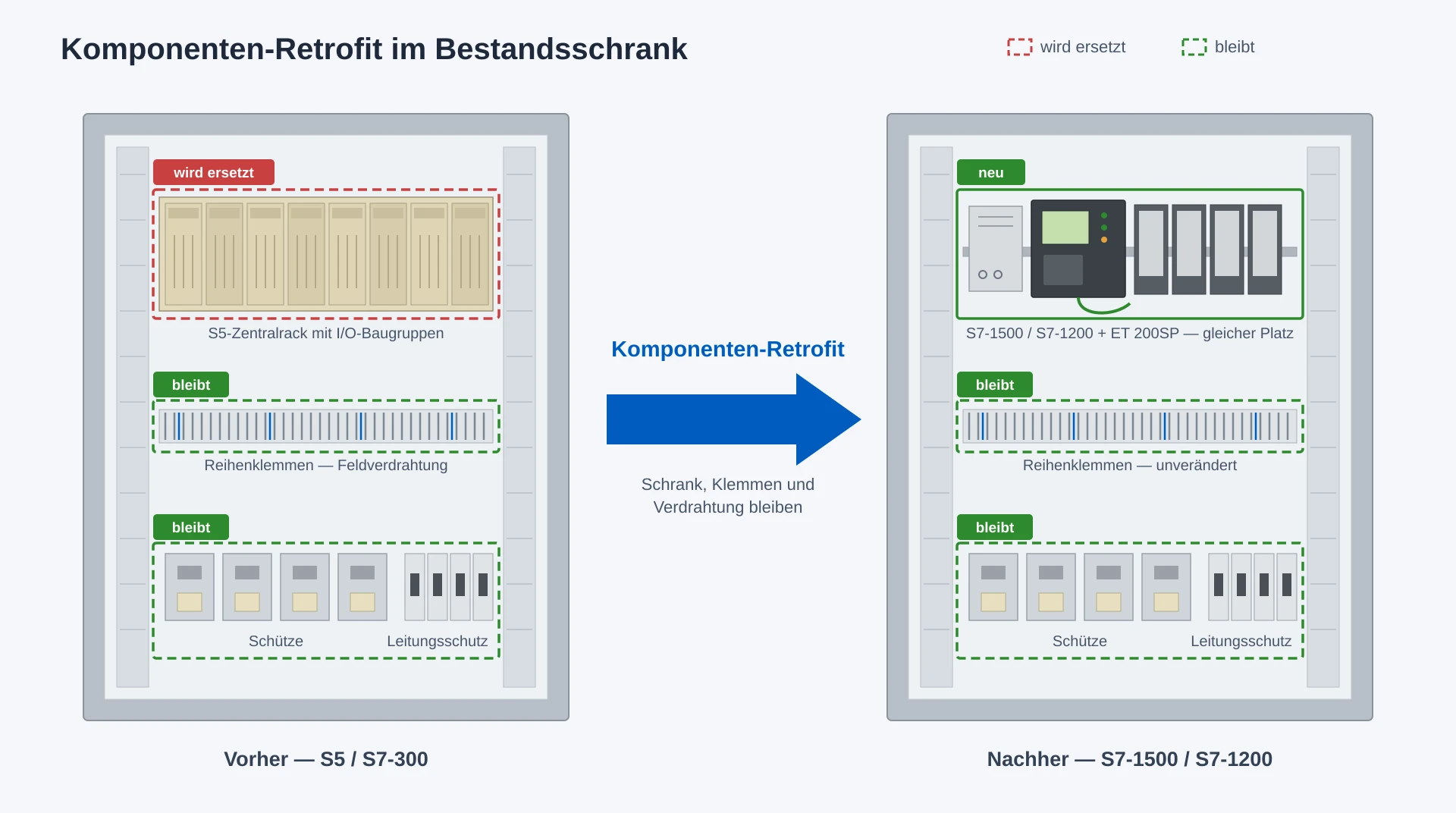
- replaced — cabinet & wiring remain
- CPU + I/O
- replaced — cabinet & wiring remain
- of downtime instead of weeks — known in advance
- A few days
- of downtime instead of weeks — known in advance
The S7-300 has been discontinued since October 2025, and the S5 has long been without official spare-parts supply. A structured component retrofit brings your plant up to the S7-1500 or S7-1200 including a new WinCC Unified visualization — fully tested on real target hardware before your plant stops.
Why now?
Three deadlines currently drive the schedule of every retrofit:
- The S7-300 is discontinued (PM410, October 2025, 268 modules) — spare parts and repairs are only available until around October 2033, and prices are already rising.
- The EU Machinery Regulation 2023/1230 applies from 20 January 2027 with no transition period — anyone who completes and documents their retrofit in 2026 is still assessed under the familiar rules of the old directive.
- Modern plant technology speaks PROFINET and OPC UA — an S7-300 or S5 can no longer connect cleanly to these systems.
Component retrofit instead of a complete rebuild
If the control cabinet is mechanically and electrically sound, only the automation level is replaced: CPU, I/O modules and operator device. Terminals, line protection and wiring stay in place. A real example from the Greater Region: S7-300 out, S7-1200 including a Unified Basic Panel in — in the existing cabinet, on the existing wiring, with updated circuit diagrams. From a single source and considerably cheaper than any complete-rebuild offer.
No offline project left? Not a problem.
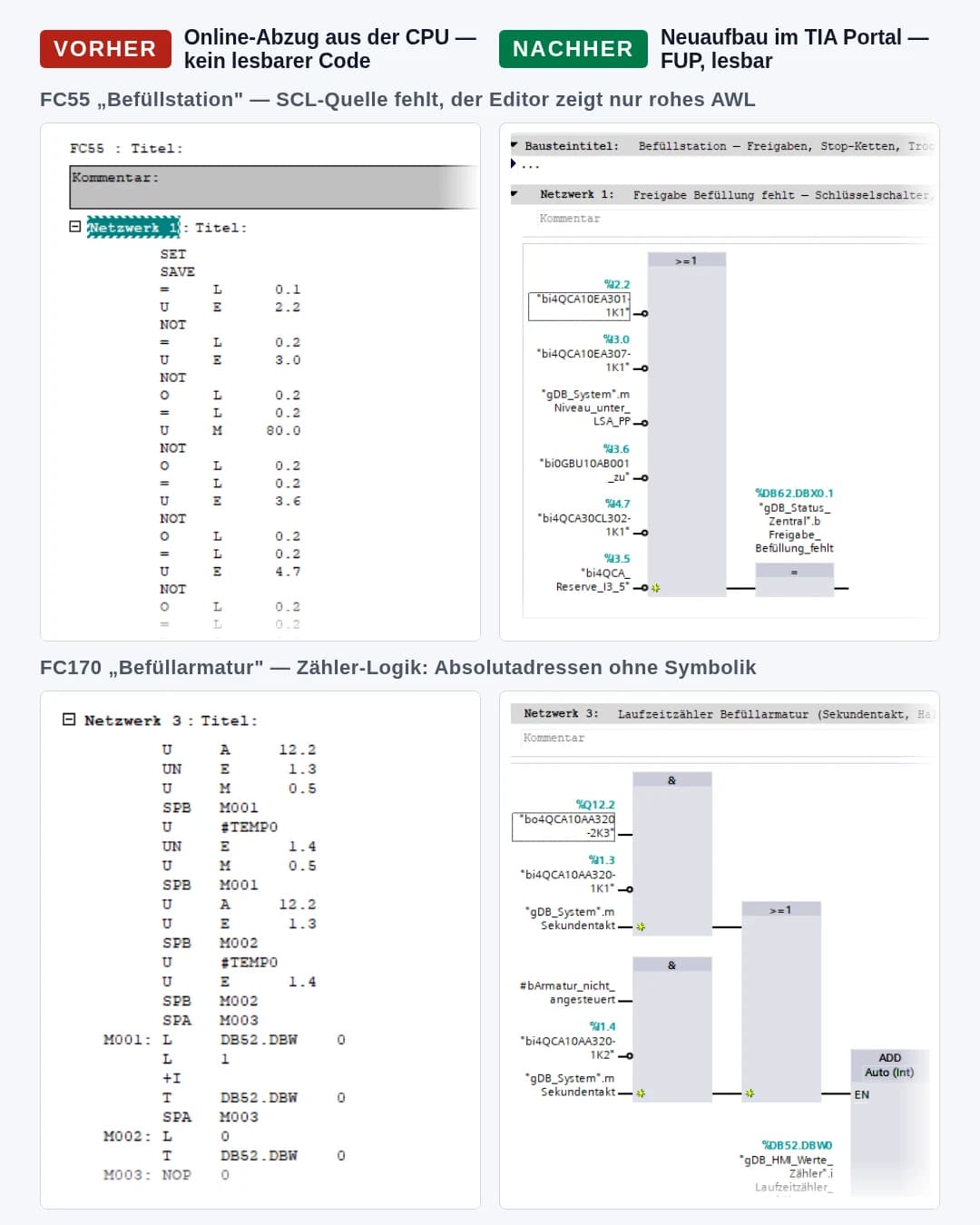
On legacy plants the original project is often lost — the company that wrote it no longer exists, and all that remains is the online upload from the CPU. It contains neither symbols nor network comments, and without the SCL sources the editor shows nothing but raw STL. Migrating such a program 1:1 would only preserve its unreadability. Instead, a clean new program base is created:
- Symbols from the circuit diagram: the symbol table is reconstructed from your schematics — even from scanned PDFs, extracted with AI support and structured to a consistent naming convention.
- The logic stays, readability returns: the online upload serves as the reference for the proven plant logic, and the program is rebuilt throughout in FBD — with network comments and meaningful data block names.
- Afterwards, the next maintenance technician understands again what the plant is doing — extensions and troubleshooting are no longer guesswork.
How your retrofit works
Six steps from the legacy system to a modern controller:
- Site survey — the PLC program is the source of truth; the circuit diagrams are checked against it. If the offline project is missing, the online upload is secured and the symbols are reconstructed from the circuit diagrams.
- Hardware mapping — every module gets its successor; any intervention in safety functions is flagged before the order, so your safety assessment doesn't reopen afterwards.
- Program rebuild — symbolic names and blocks to standard rather than a 1:1 carry-over; the proven plant logic is preserved.
- HMI rebuild — WinCC Unified with a consistent screen concept and web access instead of carried-over legacy screens.
- End-to-end test — the complete system runs beforehand in the test setup on real target hardware; every button, every message, every sensor.
- Commissioning & handover — with revised circuit diagrams, symbol tables, HMI documentation and the safety records from the software side.
Affordable through structure and tools
One person in charge instead of many departments, AI-accelerated engineering for the legwork — you pay for the work that requires experience. Importantly: no AI runs in the controller itself. The PLC works with deterministic, tested logic — exactly as safety and standards require. As a bonus, OPC UA gives the plant a standardized, read-only data interface — the foundation for monitoring and analysis.
Related services
PLC Programming (TIA Portal)
Structured programs from a proven block library — tested before commissioning.
PLC Programming (TIA Portal): Structured programs from a proven block library — tested before commissioning.HMI & Visualization (WinCC Unified)
Plant schematic, SVG device symbols, individual pop-ups and web access — to a screen concept.
HMI & Visualization (WinCC Unified): Plant schematic, SVG device symbols, individual pop-ups and web access — to a screen concept.Commissioning & End-to-End Test
The complete system tested beforehand — on the hardware that will later work at the plant.
Commissioning & End-to-End Test: The complete system tested beforehand — on the hardware that will later work at the plant.Frequently Asked Questions
What does a control system retrofit cost?
As a rule of thumb, a component retrofit costs between 30 and 60 percent of a complete new control cabinet — only the automation level is replaced; the cabinet and wiring remain. The specific scope depends on the existing system — which is why every project begins with a site survey and a reliable cost framework rather than a shot-in-the-dark estimate.
How long will my plant be down?
Programming and the complete system test run beforehand in the test setup — at the plant it is only a matter of rebuilding, testing and starting up. The downtime window is therefore typically an extended weekend to a few days, and it is known before the rebuild.
We no longer have an offline project, only the running plant — is a retrofit still possible?
Yes — this case is more common than you might think. The online program is uploaded from the CPU; it provides the plant logic even though symbols, comments and SCL sources are missing. The symbol table is reconstructed from the circuit diagrams, and the program is then rebuilt in readable FBD instead of being carried over unreadable. Strictly speaking this is no longer a migration but a re-engineering — with the advantage that your plant ends up with a documented, maintainable software base again.
Does the control cabinet have to be replaced?
In most cases, no: the automation level is replaced, the cabinet and its wiring stay in place. If the cabinet really is at the end of its life, a control-cabinet-building partner company handles the new build — software, visualization and commissioning remain from a single source.
What documentation do I receive at handover?
Revised circuit diagrams showing the plant's real final state, complete symbol tables and block documentation, HMI operating documentation and training for operators and maintenance. For failsafe programs, the safety records from the software side are added: documented safety functions, achieved performance level, F-parameters and test records. What I don't take on is the CE assessment itself — I provide software and engineering services and don't place machinery on the market. Conformity assessment and declaration remain with the operator or the machine manufacturer; my documents feed in there as evidence. All details on the process are in the retrofit guide on the blog.
A site survey instead of gut feeling
Module risk list, program and documentation check, a reliable cost framework — as a standalone, manageable service before any commitment.
✓ Non-binding initial consultation ✓ Response time < 24h on business days